As time went by and the cows ran out, the king started to kill buffaloes as food for the crows. However, people could not accept this and walked to the Royal Palace to protest it. (This shows that democracy has occurred for a long time). The king, then, stopped killing cows and buffaloes making the crows angry and find a way to get rid of the king. (This is probably the origin of a saying of people from northern Thailand that “To please a vulture, you upset the crow. To please the king, you upset the god.)
The crows tricked the king that they wanted to carry him to another land which is very big with a lot of treasures. Out of greediness, the king agreed to rule that land. He, then, used the same method of making a basket for the crows to carry him. However, this time, the crows took him to an island in the ocean. Finally, the king died on this island and became a crab living in Tam Mi Lab pond.
At Chanta Kham City, there was a big rain for many consecutive days causing flood which made the people go up to the mountain to escape. That flood changed the whole town into a pond and was called “Nong Tam Mi Lab” or Nong Tam Mi La.
Later on, there was a hermit named “Tung” who was the son of Phaya Wong (Wong Tee Fang), the king of Ho City (Yunnan). This hermit and his 3 siblings arrived at Nong Tum Mi Lab and made a deep water drain with his walking stick to allow water to flow into the ocean leaving only one big pond later called Nong Tung after the hermit. The current of water in that river was northwards so it was called Nam Keun (up water), which became the name “Tai Keun” later on.
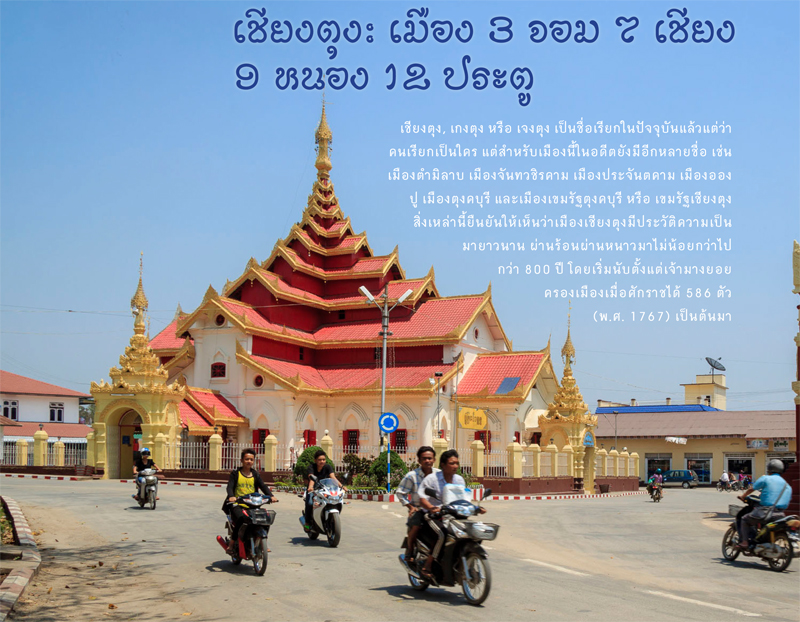
The king whom Chiang Tung people respected for building up security and fighting for Chiang Tung was Chao KonKaewRattanaInThalang. Next were Chao Kong Tai and finally, Chao Chai Luang, the 46th king, before the city being ruled by Myanmar and the royal palace destroyed in 1991. Despite of protests from many parts, Myanmar ruined a symbol of kingship by changing the royal palace into New Chiang Tung Hotel.
Some people might say that Chiang Tung now is tens years behind Thailand. In terms of infrastructure, it may be true. For example, the roads are covered with a lot of dust. People need to hire a car to commute. There seems to be no electricity and internet. Some hotels may provide wi-fi internet but sometimes the power is out.
This city may not be a good choice for tourists who prefer convenience. However, if you would like to find something that is missing in Thailand or to see Lanna people, here is the last place before it will be gone with globalization.
Temples were a major target that the writer was really interested in. Next was the lifestyle of Chiang Tung people, their tribes, races, especially Tai Keun language, which very similar to Tai Lanna and Tai Leu.
On the first day of our trip, our female guide from Tai Yai who spoke fluent Thai took us to KadLuang market. At first, we were unhappy because it looked like Mae Sai market. However, as we took a better look, we could notice the lifestyle of locals that was blended well with the city expansion. This market offers various types of products from vegetables, fish, gold, etc. In a gold shop, I was walking around to take pictures until the shop owner gave me a look. Here, there were no bars, a security guard or police officer in a gold shop. Only shop owner and customers standing and facing each other in a small shop in the market not made to provide so much security. There are no thieves here because everyone knows each other. Also, the roads are not as complicated as in Bangkok. Most of all, people here stick to the honor system and are not so tricky only a little while doing business. For example, when our staff asked about the price of noodle, the shop owner said 5,000 Jyat (150 Baht). As our guide asked again, he changed to 1,000 Jyat (30 Baht). I am not sure if he intentionally did that or it was because of miscommunication.
From KadLuang market, we took a tricycle prepared for us back to HuaKuang Temple or RatchathanLuangHuaKuang. At this temple, there are some architecture built to support monk’s education from a group of Thai monks led by SomdejPhramahaRatchamangkalajarn, PaknamPaseecharoen Temple, Bangkok.
You should be prepared for visiting temples in Chiang Tung. This is because Vihara in each temple has Tai tribal style of which the roof covers almost half of the building making it a little too dark inside. To take pictures, you need to use high value of ISO or RAW file if possible. Then, use Photoshop to edit the file to look more natural.
From HuaKuang temple, we walked further to Phra Chao Luang Ra Kang Temple or PhramahaMayamunee (duplicate), which is in the city center next to HuaKuang Temple. After that, we went to see Nong Tung passing New Chiang Tung Hotel, the former royal palace or Hor Kham.
At Nong Tung, we can see a big Buddha image pointing a finger to the city. This place is JomSak at where a Buddha image in foretelling posture or pointing Buddha according to the legend of Phra Chao LiabLok.
As we continued our journey, we found a local restaurant beside the street. There were some food we liked and did not like. However, to me, everything was delicious.
After leaving JomSak, we went to Jom Kham, which is an old PhraThat of the city. Here, you will see a small stupa in Langka style which looks like a bell next to Jom Kham stupa. This is evidence that Buddhism, Langkawongschool was transferred here through Lanna during 6-700 years ago.
From Jom Kham, we went on to Jom Mon or Jom Bon (as in Tai Keun document). There is a big rubber tree as the highlight that can make visitors forget about Phra That Jom Bon, a sacred architecture of Chiang Tung. Local people believe that the 3 Jom including Jom Kham (Jom Tong), JomSak and Jom Mon (Jom Bon) are like tripod supporting Chiang Tung to be stable and secure. If ignoring this belief, this tripod represents Buddhism, art and culture that build up Chiang Tung.
After taking pictures of the atmosphere and paying respect to Phra That Jom Bon, we got back to MeiltThit market, which means new market. Here, we took pictures and bought some snacks before going back to take some rest.
During these four days, all we did was going to markets and temples. Despite of this, we still missed many temples. However, we had a chance to observe a class in Thai Race School which is a language school teaching Tai Yai, Tai Keun, Thai, and English. Here, we could feel students’ motivation to study as they carried a small chair to sit in the Vihara of Phra That HuaSua Temple. The students’ voice when reciting Tai Yai alphabets came through a bamboo building. Comparing to Thailand, some students study in an air-conditioned room but they do not pay attention as much as they should.
From Phra That JomDoi, we passed EnnHua Lung village and went to Chao Boon Thip Temple, which is a strict monk who is called as “Chao Sil Man” by locals. There are more than 70 novices in this temple, which is another interesting picture to take. Any kind of meat is not allowed in this temple area.
After leaving this temple, we went to visit Ban Enn-a village of Enn tribe in which houses are built on the mountain. At first, I was going to give some small money to the kids standing and looking at us. However, the guide asked me not to do so otherwise it would make them dependent. The guide also said that if I wanted to help, I’d better buy their hand-woven cloth. We did so in order to support them to be self-reliant.
During these 4 days, we got some experience missing in Thailand. We learned about another culture and lifestyle as well as built good friendship. We can say that we gained more than what we lost in this trip. Although the journey was a bit inconvenient, we were really impressed by this small city and people. We would like to thank Mr.Songsaeng from Sang Sook Thai Foundation who facilitated our travel. Recently, there has been a trend of cultural tourism. Also, Chiang Tung will be a World Heritage site in 2020. Culture is deep inside people’s minds and it takes a long time to develop. It is difficult for tourists to understand culture within 3-5 days. This is more likely going to be a chance for those who seek benefits to take advantage of this event in making money for themselves.
Therefore, Chiang Tung can become a World Heritage site because of the locals who live there not outsiders. Making Chiang Tung a World Heritage site requires great and round consideration of pros and cons.